BELLS RESTORATION


The Bells of St Mary’s


Every person in England is familiar with the sound of church bells. Whether it’s bells being rung in the local village or city church or bells being heard on television during Royal or State occasions, everyone knows what the sound is. It’s part of English culture and it’s only done in England, plus a little in the other parts of the British Isles and in countries such as Australia and the USA, which have a strong English background.


The bells do not ring tunes, nor is one person sounding many bells, as happens in other parts of the world. Here, each bell has its own ringer and the ‘pattern’ of sound produced is known as change-ringing.


Bells have a religious dimension to them as well. In the 17th and 18th Centuries, when virtually everyone went to church every Sunday - sometimes through an Act of Parliament requiring them to do so - and when domestic clocks were not common, people knew it was time to get ready to go to church when the bells started ringing. The bells ‘called them to church’.


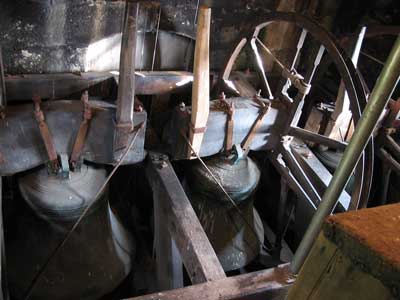
I suppose it’s not universally known that church bells rotate in a full circle when they’re rung, first one way and then the other. To enable them to do this they have to be built into a church tower like a piece of heavy machinery.


The crowns of the bells have to be fastened to large blocks of timber or steel (headstocks), which themselves have axles protruding from their ends which sit into bearings, to enable the bells to turn.
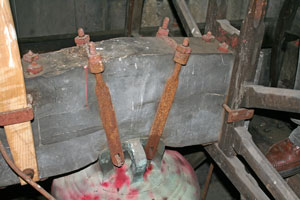
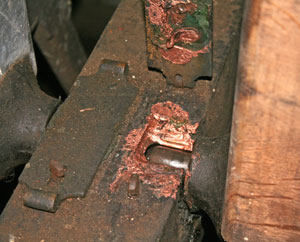
Wooden headstock of a bell        Headstock bearing of a bell
( The red marks seen on the bells is from the die used to detect the cracks. )


The whole ensemble has to be mounted in a substantial wooden or steel frame to take the force of the rotating bells. The frame then has to be securely built into the tower walls. The bells are ‘controlled’ by the ringers by ropes fitting into a groove on the outside of large wheels fastened to the headstocks.


The technology of bell hanging has hardly changed since the 18th century and this is what we have in St. Mary’s church, with our three bells weighing over a ton altogether. We have however a layout of the machinery which is probably unique. The tower is not an open structure down which the bell ropes can hang, as is usual. It’s essentially a solid structure with a spiral staircase built inside it. As a result, the bell ropes have to fall into the church nave, close by the wall.


The centuries have taken their toll, as they do with any machinery. Two bells now have short, hairline cracks in their crowns, resulting from the old-style foundry practices common in 1762 when the bells were made. The frame is sound, but it’s no longer securely fixed into the tower walls. The bearings are worn out. The list goes on. The machinery needs a complete overhaul. And that’s what the PCC decided to do about two years ago. The decision was also made to install some ancillary hammers so that the bells can be lightly ‘sounded’ by anyone, when experienced bellringers are not to hand.


The big question was ‘where do we get the money from?’ Long Preston Parish Council came up trumps as soon as it knew one of the village’s gems was in danger of becoming derelict and various parishioners contributed very generously. But it still left us some tens of thousands of pounds short. We had to approach national charities for the outstanding money.


In the end, the Parochial Church Council (PCC) applied to five charities; some were not forthcoming, whilst others gave token amounts. We therefore put our major efforts into a bid to The Heritage Lottery Fund, which, because of its nature (as its title indicates) will only support bids with a big heritage aspect. A group of parishioners who were interested in exploring the history of the village came to the rescue and joined their plans to the bid, thus giving it much of the heritage strength required. As everyone knows, the bid was thankfully successful.


As a measure of the bureaucracy to date, we’ve had eight visits to the church by various bellhanging firms and structural engineers, we’ve had to consult English Heritage, the Council for the Care of Churches, the Society for the Protection of Ancient Buildings, the Yorkshire Dales National Park Authority, an Archaeologist and the Bradford Diocese’s Advisory Committee, several of which made their own visits. The Diocese has now givien us the formal Faculty to get on with the work.


The bids to the charities were very time-consuming: that to The Heritage Lottery Fund alone being a one-inch thick submission, running to detailed answers for 122 questions and to assembling dozens of pages of supporting documents. All in all, I estimate there’s additionally been over a hundred letters, engineering drawings and emails sent and received so far.


And that’s not the end. In accepting the HLF grant, the PCC has had to enter a legal agreement, which is itself a half-inch thick document with 26 legal conditions attached, controlling how the HLF’s money is spent. During the course of spending, the HLF require us to submit detailed progress reports  to show that we’re doing the things we said we would do in the bid and to the timetable we gave. This extends over five years until the Village History work is complete.

                                                                                                        Robert Cater - PCC Secretary

The tower of St. Mary's Church, where the bells hang, is Norman at the base and is rare, being solid in
the lower part. From the outside the tower appears no different from any other church tower. But in Norman times it was built for defensive purposes and so the lower stage is essentially solid masonry.
After demolition of the old steeple in 1760, an upper storey complete with elegant pinnacles, was added for the insertion of three bell which date from 1762. These were cast in the Whitchapel Bell Foundry with the largest weighing around 8cwt.  They hang side by side in a well preserved oak frame installed by Mallaby of Masham in 1887.

In nearly all other bell towers the robes hang straight down inside the tower. Because this tower is solid, the resourceful bellhangers passed the ropes through the roof space of the nave to fall in a straight line no more than nine inches from the tower wall. This ringing position is "very unusual if not unique".

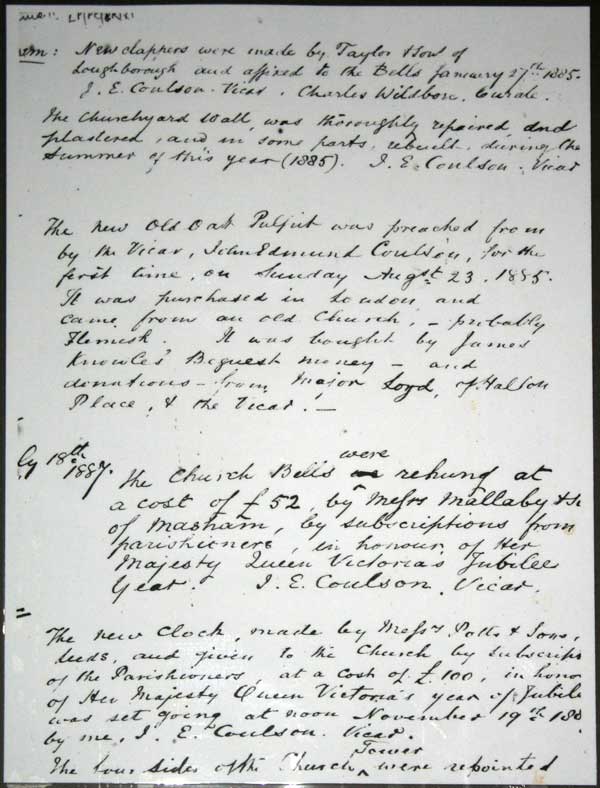
The bells were re-hung in 1887 when the clock was installed.
Extract from Church Records
In the late 1990's an appeal to restore the bells was launched and a great deal of work was undertaken to research the task and identify suitable funding. Removing the bells for restoration is more difficult than in an open tower as the bells would need to be craned out through the tower wall or roof.

This project was put on hold for various reasons and was finally resurrected in 2008 as part of a wider
Local Heritage Project for the village which obtained a grant from the Heritage Lottery Fund.

With the Heritage Lottery Grant of £19,980 for the Bells Restoration confirmed in June 2008, work on the bells could begin in December with the hope to have our bells ringing out once again by Easter 2009.

Generous help from Long Preston Parish Council, and other donations including Heather's sponsored walk, The Yorkshire Association of Change Ringers, and the tour around Hellifield Peel, had by then raised £10,000. When this was added to the Lottery grant, the Parochial Church Council had enough money to
 pay for the bells work.
The bells have been a part of village life since the 18th Century. As well as local occasions such as weddings and funerals, and to mark Sunday Services, the bells have been rung to proclaim significant national events - Coronations, the end of World wars, the Millennium Festivites. Before pocket or wrist
Watches were common local people in the lanes and fields of the village would have relied on the bells to tell the time via the sounding mechanism operated by the clock.
Two of the three bells were silenced in September 2006 after the Bellfounders discovered short hairline cracks in them, caused by the 18th Century founding techniques and excessive movement of the beams that support the bell frame. The lightest bell of the three could be sounded for Church Services only.
The hour bell could no longer be struck to sound the hours and the characteristic 'peal' of bells was no longer heard.
  
Drawing by D. Greenwood, showing damage to Tenor Bell.